

Government contracts are at greater risk than ever before. In today’s environment:
- The Department of Justice (DOJ) is increasing its use of the False Claims Act (FCA) to pursue contractors for non-compliance, creating substantial legal and financial exposure. In FY 2024, DOJ recovered more than $2.9 billion in settlements and judgments, and by the second quarter of FY 2025 recoveries had already reached approximately $1.257 billion.
- Cybersecurity standards are becoming more stringent and explicit. Under the forthcoming 48 CFR rules, CMMC 2.0 will move from voluntary to contractually binding, including a mandate for annual compliance affirmation signed by the CEO or CFO.
- Agencies expect clear accountability for cybersecurity compliance, not just technical controls.
- Supply chain and subcontractor vulnerabilities can introduce compliance failures and security breaches that put prime contractors at risk.
- Sophisticated cybersecurity threats targeting government contractors are evolving rapidly, exploiting gaps in operational technology, cloud environments, and vendor networks.
One of the most common underlying causes of these risks is cybersecurity efforts are made in isolation from business strategy. Without alignment, even well-funded cybersecurity programs can leave contracts vulnerable, raising the stakes for executive leaders by jeopardizing performance, renewals, and competitiveness in future bids. Cybersecurity is no longer measured solely by technical controls; it also requires documented evidence, defined responsibility, and clear leadership accountability.
This article outlines how business alignment combined with cybersecurity investment drives contract acquisition, retention readiness, reduced risk, stronger competitiveness, and agency trust. Retention readiness means maintaining performance, trust, and eligibility throughout the life of the award.
In addition, misalignment can be introduced by governance gaps, third-party weaknesses, and laws which have the authority to raise requirements mid-contract with little notice, such as the Defense Production Act (DPA) or forthcoming 48 CFR updates (we expect in October). Building on these dynamics, and given the current and future state of affairs, we have identified six high-risk industries most likely to face accelerated mandates under measures such as DPA or similar federal authorities:
- Energy storage and grid resilience
- Food supply chains and distribution logistics
- Pharmaceutical manufacturing and API+ sourcing
- Transportation infrastructure
- ICS/OT across critical infrastructure (across multiple industries)
- Cyber warfare threat response (across multiple industries)
Closing the gap between business strategy and cybersecurity readiness requires a structured, integrated approach Our advisory model applies the Compass Readiness Framework (CRF), a framework-based evaluation tool built on structured executive interviews, to surface gaps across mission objectives, operational resilience, governance, financial readiness, boundary strategy and controls, supply chain resilience, assessor readiness, and government alignment. The results provide executives with clear insights into where vulnerabilities exist, creating a foundation for informed decisions and next steps. Applying these insights to close gaps creates the alignment needed to reduce the risk of contract disruption, strengthens bid competitiveness, lowers legal and financial exposure, and builds trust with contracting agencies, ultimately turning readiness into a strategic advantage.
In summary: contract acquisition & retention readiness is not a compliance exercise; it is a leadership priority. Executives who act now to identify and close gaps across all readiness domains will be best positioned to win, protect, and grow government and defense contracts in a rapidly changing threat and regulatory environment.
The Hidden Gap: Business Strategy and Cybersecurity in Government Contracts or Defense Contracts
In many government and defense contracts, cybersecurity is treated as a standalone IT function rather than a core component of business strategy. This separation creates a blind spot where technical defenses exist, but the organization’s broader operations, governance, and financial planning are not aligned to support them. The result is a gap between what is implemented in the security program and what is required to protect contracts over their entire lifecycle.
Common causes of misalignment include:
- Budget allocation that stops at technology. Spending may be concentrated on tools and software while neglecting investments in governance, training, or operational resilience.
- Governance silos between departments. Security, compliance, operations, and executive leadership often operate with separate priorities and communication channels, which are not always aligned, leaving critical risks unaddressed.
- Reactive investment patterns. Funding and resources are often released only after an incident or audit finding, forcing the organization into a cycle of catching up instead of staying ahead.
When these type of systemic business gaps persist, the consequences reach far beyond IT. Agencies increasingly evaluate cybersecurity as a deciding factor in contract awards, renewals, and ongoing eligibility. Misalignment can:
- Lead to missed bid opportunities or undermine competitive standing during the bid process.
- Trigger penalties or even contract termination if performance suffers due to security failures.
- Increase exposure to legal disputes, financial loss, and reputational damage that is difficult to repair in government and defense markets.
The takeaway for executives: cybersecurity cannot be effective if it operates in isolation. It must be woven into the fabric of business strategy, governance, and operations to close the readiness gap. As later sections will show, this gap not only threatens day-to-day performance but can quickly widen under third-party failures, policy shifts, or sector-specific risks that raise the bar mid-contract.
Contract Acquisition & Retention Readiness: A Business Imperative
Government and defense contracts are no longer awarded and retained on technical performance alone. Agencies now assess an organization’s cybersecurity maturity as a core component of contract performance, including its ability to safeguard operations, protect sensitive data, and sustain delivery under pressure. This evolution means contract acquisition & retention readiness is both a competitive differentiator and a compliance necessity.
A business-first approach to cybersecurity is critical in this environment. Traditional methods often focus narrowly on tools, controls, or passing audits. While these are important, they are not enough to ensure contract continuity in a landscape shaped by evolving threats, shifting regulations, and heightened public scrutiny. By contrast, a business-first approach begins with the mission, operational goals, and governance structures, then aligns cybersecurity to protect those priorities.
When viewed through this lens, cybersecurity becomes more than a compliance function. It becomes an enabler of:
- Bid competitiveness. Demonstrating measurable cybersecurity maturity increases trust with contracting agencies.
- Contract longevity. Integrated security and governance reduce the risk of mid-contract penalties or terminations.
- Operational resilience. Preparedness to adapt to new requirements, incidents, or external pressures without disrupting delivery.
Cybersecurity initiatives must be part of a broader readiness strategy that strengthens the organization’s ability to meet contract obligations today and adapt to tomorrow’s demands. The alignment of mission, operations, governance, and technical defenses is what turns compliance into a resilient position in the market.
Business Alignment and Cybersecurity: The Formula for Contract Success
Securing government and defense contracts is not a matter of choosing between business priorities and cybersecurity. It requires the deliberate integration of both; two sides of the same equation, each multiplying the value of the other.
Business Alignment sets the foundation:
- Operational readiness. Processes, roles, and resources are structured to deliver consistently on contractual obligations.
- Governance clarity. Decision-making authority, accountability, and oversight for cyber risk are clearly defined at the leadership level.
- Risk ownership. Contract-related risks are not left to IT alone but are managed across legal, finance, operations, and security teams.
- Financial readiness. Budgets anticipate ongoing compliance needs, technology refresh cycles, and evolving regulatory requirements.
Cybersecurity Initiatives provide the capability:
- Integrated risk management. Tools and processes are chosen for their ability to protect mission-critical operations, not just satisfy audit requirements.
- Skilled people and trusted partners. Teams have the expertise and external support to address evolving threats.
- Continuous monitoring and improvement. Security posture is tracked, tested, and adapted in real-time to changing conditions.
- Supply chain security. Vendors and subcontractors, including downstream dependencies, are vetted and monitored to meet or exceed contractual cybersecurity requirements.
- Incident preparedness and recovery. Tested response plans and clean backups enable rapid containment and restoration without disrupting contract performance.
When these two elements operate in isolation, the result is wasted effort:
- Secure systems do NOT meet business needs.
- Business strategies that CANNOT withstand a cyber incident.
However, when alignment and investment work together, the organization gains:
- Resilience to adapt to changing requirements without disrupting delivery.
- Trust strengthens relationships with contracting agencies.
- Competitive advantage in winning and retaining government and defense contracts.
- Reduced risk across operational, financial, and compliance domains.
The equation is simple in concept but challenging in practice:

This formula ensures that every security decision supports contract performance, and every business decision is made with security and compliance in mind. It is the operating model that prepares organizations not just to pass an audit, but to remain competitive over the long term.
How Gaps Emerge in Real-World Contracts
Even well-resourced organizations run into problems when gaps appear between business strategies and cybersecurity efforts, including losing bids, having work halted, or facing penalties. These gaps can surface at any point in the contract lifecycle, often without warning, and in ways that put revenue, reputation, and contracts at risk.
The following scenarios illustrate how these vulnerabilities appear in practice and why proactive readiness is essential.
- Bid Lost Due to Inadequate Documented Cybersecurity Governance - Strong security measures can still fail to win a contract if documentation does not meet an agency’s standards. Without clear, verified governance records (e.g., policies, risk assessments, incident response plans) evaluators may mark the bid non-compliant.
- Mid-contract suspension after failing an unannounced inspection – Many contracts include provisions for unannounced audits. An organization that passed the initial review may still fail later if readiness is not maintained. Agencies can suspend work until deficiencies are corrected, causing delivery delays, cost overruns, and potential reputational harm.
- Audit-Only Compliance Can Hide Systemic Weaknesses – Passing an audit can create a false sense of security. Checklist compliance that is not integrated into daily operations can leave critical gaps, allowing real-world incidents to disrupt performance despite being “compliant” on paper.
- Third-Party Risks That Undermine Prime Contractors – Subcontractors, suppliers, or technology vendors with weaker cybersecurity maturity can jeopardize the entire contract. A single vulnerability in a partner’s system may lead the agency to hold the prime responsible, forcing them to absorb remediation costs or face penalties.
- External Forces Raising the Bar for Contract Acquisition & Retention Readiness – Regulatory changes, external policies, and laws are reshaping the compliance landscape. At the end of 2024, CMMC 2.0 was updated. On June 9, 2025, DoD issued a memo on Commercial-Off-the-Shelf (COTS) Information and Communications Technology and Supply Chain Risk Management. Two major shifts are on the horizon: 48 CFR expected in October, and potential activation of the Defense Production Act (DPA) as geopolitical pressures escalate. These measures may impose new security mandates, shorten timelines, or require supply chain changes mid-contract, creating significant challenges for organizations that are not prepared.
Over the past decade, both the threat landscape and regulatory expectations have shifted significantly. With rising cybersecurity threats and ongoing geopolitical tensions, the Defense Production Act (DPA) may soon be triggered for specific sectors, creating new pressures for contract readiness.
The Defense Production Act (DPA) can reshape both business and compliance requirements overnight, forcing companies to shift production, delivery, and standards without warning. For further reading, see this article by Tenley Carp, Partner with AGG (Arnall Golden Gregory LLP): From Private Company to Government Contractor Overnight: How the Defense Production Act Can Transform Your Business Without Warning.
Six Sectors at Highest Risk Under DPA
Industries classified as part of our nation’s critical infrastructure are prime candidates for accelerated cybersecurity mandates. Specific sectors face a heightened likelihood of rapid requirement changes if or when the Defense Production Act (DPA) is activated. As noted earlier, we have identified six sectors where DPA activation could impose more stringent mandates with little lead time, increasing the risk of gaps between business strategies and cybersecurity readiness.
Energy Storage & Grid Resilience
National Security Context: The stability of the national power grid is critical to defense, emergency response, and economic security. As renewable energy sources expand, large-scale energy storage systems have become a cornerstone of grid resilience and are increasingly designated as part of the nation’s critical infrastructure.
Operational Risks: Disruptions to grid operations can cascade across sectors, affecting transportation, healthcare, communications, and defense. Supply chain dependencies for specialized components and materials can delay repairs or upgrades, prolong outages, and undermine contract performance.
Technology Risks: Energy storage facilities and grid management systems rely on industrial control systems (ICS) and operational technology (OT) connected to digital monitoring and control networks. These systems are vulnerable to cyber intrusions that can cause operational shutdowns, data manipulation, or equipment damage. Integration with AI-driven demand forecasting and automated load balancing increases efficiency but also expands the potential attack surface.
Potential Contract Impacts: Requirements for advanced ICS/OT cybersecurity controls, continuous network monitoring, and third-party vendor security assessments; mandatory incident response drills; and compliance with sector-specific standards such as NERC CIP.
Food Supply Chains & Distribution
National Security Context: The food supply chain is a cornerstone of public health, economic stability, and national security. Disruptions to production, warehousing, or distribution can have immediate impacts on communities and critical operations, especially in times of crisis.
Operational Risks: Heavy reliance on just-in-time delivery models and centralized distribution hubs means that even minor disruptions can ripple across large geographic areas. Transportation bottlenecks, labor shortages, and vendor dependencies can compound these risks, undermining contract performance.
Technology Risks: Modernized food logistics increasingly depend on connected warehouse systems, cloud-based inventory platforms, GPS-enabled fleet tracking, and automated distribution routes. Many of these systems now integrate AI for demand forecasting, route optimization, and inventory management, which improves efficiency but also broadens the potential attack surface. Legacy ERP systems and centralized data storage create high-value targets for ransomware and other cyberattacks.
Potential Contract Impacts: Mandated migration from legacy platforms, advanced threat detection integration, and strict continuity-of-operations planning.
Pharmaceutical Manufacturing & Active Pharmaceutical Ingredient (API) Sourcing
National Security Context: Domestic manufacturing of active pharmaceutical ingredients and critical medicines is a national security priority. While relocating production increases control over physical security, it also demands strict oversight of sourcing, quality, and regulatory compliance.
Operational Risks: Supply chain disruptions, vendor dependencies, and quality control failures can halt production and delay critical deliveries.
Technology Risks: Digital supply chain systems track sourcing, quality, and compliance. These are often connected through application programming interfaces (APIs) and increasingly enhanced by AI for forecasting, monitoring, and automated quality assurance. While this improves efficiency, it also broadens the attack surface, making these systems attractive targets for cyberattacks that could disrupt production or compromise product integrity.
Potential Contract Impacts: Required NIST-aligned security baselines, software bill of materials (SBOM) for manufacturing systems, and advanced monitoring of smart manufacturing networks.
Transportation Infrastructure
National Security Context: From ports and rail to air and highways, transportation systems are vital to the movement of goods, people, and defense resources. These assets are considered critical infrastructure and are subject to heightened federal oversight and evolving cybersecurity requirements.
Operational Risks: Disruptions in transportation can create cascading effects across supply chains, emergency response, and public safety. Dependencies on third-party operators, maintenance providers, and interconnected systems increase the potential for delays, congestion, and missed contractual obligations.
Technology Risks: Modern transportation infrastructure relies on connected control platforms, IoT-enabled logistics, GPS fleet and cargo tracking, and automated scheduling systems. Many of these platforms now integrate AI for traffic optimization, predictive maintenance, and cargo routing, increasing efficiency but also expanding the attack surface. Outdated operating systems, insecure programmable logic controllers (PLCs), and human-machine interfaces (HMIs) with long patch cycles remain persistent vulnerabilities.
Potential contract impacts: Requirements to replace insecure PLCs and HMIs, secure IoT integration, implement GPS tracking security protocols, and deploy real-time monitoring for operational technology.
ICS/OT Across Critical Infrastructure (Across Multiple Industries)
National Security Context: Industrial control systems (ICS) and operational technology (OT) underpin the operation of critical infrastructure across energy, water, manufacturing, and transportation sectors. Their compromise can have immediate national security consequences, disrupting essential services and affecting public safety.
Operational Risks: Many ICS/OT environments rely on legacy equipment that was never designed for modern cybersecurity threats. Limited downtime windows make patching and upgrades challenging, leaving systems exposed. A single failure can halt production lines, disrupt utility services, or delay critical infrastructure projects — all of which can jeopardize contract performance.
Technology Risks: ICS and OT networks are increasingly connected to enterprise IT systems, cloud services, and remote monitoring platforms (e.g., a shift from traditional close-loop systems to open-loop systems). While AI-driven predictive maintenance and process optimization improve efficiency, they also broaden the attack surface. Unsecured remote access points, misconfigured network segmentation, and outdated firmware create openings for cyber intrusion, sabotage, or data manipulation.
Potential Contract Impacts: Requirements for network segmentation between IT and OT, mandatory vulnerability management programs for legacy systems, continuous monitoring, and incident response protocols tailored to ICS/OT environments.
Cyber Warfare Threat Response (Across Multiple Industries)
National Security Context: Cyber warfare threats, whether from nation-state actors, state-sponsored groups, or highly organized criminal networks can target multiple sectors simultaneously, aiming to disrupt national security, economic stability, and public trust. Government and defense contractors are increasingly expected to demonstrate readiness to operate under such threat conditions.
Operational Risks: Coordinated cyberattacks can cause simultaneous disruptions across energy, transportation, healthcare, and supply chain systems. Without integrated contingency planning, these disruptions can halt service delivery, delay projects, or breach contractual obligations. Contractors working in multiple sectors face amplified exposure, as a single vulnerability may impact several concurrent projects.
Technology Risks: Cyber warfare scenarios often involve advanced persistent threats (APTs), supply chain compromises, and exploitation of zero-day vulnerabilities. Adversaries may leverage AI to accelerate reconnaissance, automate attacks, or bypass traditional defenses. Highly interconnected IT, OT, and cloud environments create opportunities for rapid lateral movement once an entry point is gained.
Potential Contract Impacts: Mandated participation in federal cyber defense information-sharing programs, deployment of advanced endpoint detection and response (EDR) tools, incident response coordination with government agencies, and compliance with heightened security requirements during periods of elevated threat levels.
Closing the Readiness Gaps: Strategic Actions for Executives
Bridging the divide between business priorities and cybersecurity execution requires more than ad-hoc fixes. It calls for a deliberate, sustained approach that positions contract acquisition & retention readiness as a leadership priority and an operational discipline.
1. Embed Cybersecurity in Business Strategy
Integrate security objectives directly into strategic planning cycles. Budgets, KPIs, and resource allocations should reflect not only contract performance goals but also the risks tied to regulatory requirements, operational continuity, and credibility.
2. Align and Integrate Recognized Frameworks
Adopt established models such as NIST frameworks (NIST CSF, NIST SP 800-53, NIST SP 800-171/172) to strengthen organizational resilience. For organizations operating internationally, ISO 27001 can also provide additional credibility. At the same time, establish a governance process to manage overlapping government and defense requirements such as CMMC, FedRAMP, StateRAMP, along with sector-specific mandates such as AWIA, C2M2, HIPAA, NERC-CIP, or PCI-DSS. A critical part of this process is determining which frameworks are required by law or contract versus those that are voluntary but strengthen credibility and resilience, ensuring resources are prioritized where they matter most.
3. Strengthen Governance Integration
Assign clear ownership for cyber risk at the executive level, ensuring accountability is tied to business performance and contract obligations. Governance boards should receive regular briefings on security posture, compliance readiness, and emerging risks that could disrupt delivery, trigger financial implications, undermine reputation, or result in contract loss.
4. Prioritize Continuous Readiness Over Audit Readiness
Conduct ongoing assessments, red team exercises, and tabletop scenarios to validate controls under real-world conditions. This ensures defenses remain functional long after the initial audit, reduces the risk of compliance drift, and provides documented assurance that strengthens contract performance and competitiveness.
5. Manage Third-Party and Downstream Risk as a Core Contract Requirement
Establish a structured program that begins with rigorous vetting of subcontractors, suppliers, and vendors, and continues with ongoing monitoring of their compliance performance and readiness. Risk oversight should extend beyond immediate partners to downstream dependencies that may introduce hidden vulnerabilities. Consult legal counsel to include enforceable clauses for security obligations, incident reporting, and the right to audit appropriate for the organization, industry, and state; ensuring that external relationships strengthen resilience rather than weaken it. Strongly consider enhancing the existing B2B supply chain service management system or portal.
6. Build Agility into Governance and Operations for External Forces
Anticipate regulatory and geopolitical shifts that may raise requirements mid-contract, such as new federal directives or Defense Production Act (DPA) measures. Scenario planning, flexible operational models, and proactive engagement with regulators and industry groups can reduce the impact of sudden changes, safeguard contract performance, and protect revenue continuity.
7. Invest in People and Processes Alongside Technology
Tools are only as effective as the teams and workflows that use them. Ongoing training, cross-department coordination, and clear escalation protocols are essential to sustain compliance in practice. In fact, compliance platforms typically cover only about 30% of requirements, while the remaining 70% depends on people and processes. Building maturity in these areas closes the other 70% gaps that tools cannot address, strengthening resilience, maintaining agency trust, and reducing the risk of costly disruptions.
Strategic Payoff
Cybersecurity compliance is a leadership discipline that determines whether contracts are won, renewed, or lost. Organizations that treat compliance as a sustained business priority align regulatory obligations with business goals and operations. They not only reduce the likelihood of costly disruptions but also protect revenue, strengthen competitive standing, and earn the trust that agencies look for in long-term partners.
The equation is clear: tools may cover 30% of the requirement, but it is the alignment of strategy, governance, and people that delivers the remaining 70%. Executives who master that balance transform compliance from a burden into a strategic advantage, safeguarding today’s contracts and building the maturity to position the organization to win the contracts of tomorrow.
The Compass Readiness Framework (CRF) Explained
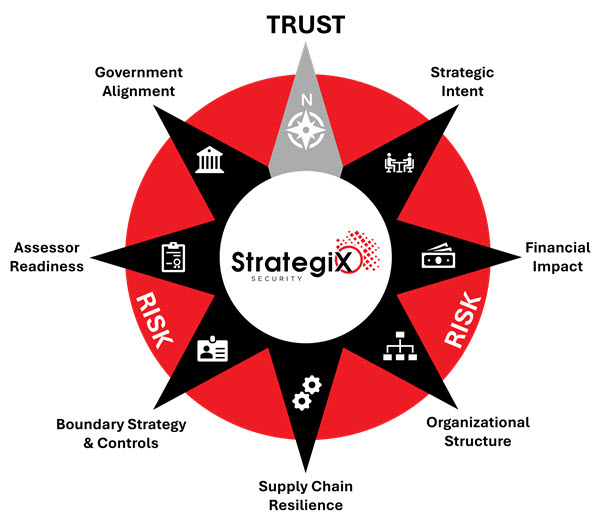
The Compass Readiness Framework (CRF) is the result of more than 35 years of cybersecurity consulting experience supporting large commercial enterprises, organizations working with the federal and defense agencies, and the agencies themselves. It is an internal diagnostic framework built on structured executive interviews that surface the key indicators of an organization’s cybersecurity compliance readiness, overall health, and long-term resilience measured against sound business metrics. Using seven critical domains, the CRF collectively determines readiness for contract acquisition and retention. Instead of focusing narrowly on passing an audit, it ensures that every operational, financial, and governance decision strengthens contract resilience.
The process begins with a 30-minute Readiness & Risk Strategy Call, designed to clarify posture, surface initial risks, and determine whether a deeper assessment is warranted. Depending on the organization’s needs, this can lead to one of two structured service paths:
- Rapid Readiness Workshop (1-Day): A focused session that surfaces systemic issues and compliance gaps, producing a readiness heatmap that gives executives a clear, visual snapshot of where vulnerabilities exist.
- Readiness Roadmap Deep Dive (Multi-Week): A more comprehensive engagement that builds on the one-day workshop by expanding interviews across a broader set of stakeholders and validating evidence. Deliverables include the readiness heatmap, a readiness roadmap, and a detailed report to support executives with strategic decision-making and prioritization.
Cybersecurity experts lead most of the structured interviews, with contributions from business / operational specialists to ensure both technical and organizational dimensions are assessed. The result is not a one-time audit checklist, but a comprehensive view of readiness that links business strategy, compliance obligations, and operational resilience, positioning organizations to win, retain, and confidently execute government and defense contracts.
Whether an organization requires targeted fixes or broader remediation, the process always begins with a 30-minute Readiness & Risk Strategy Call and advances through our structured readiness engagements. From there, remediation and implementation support are tailored to the gaps uncovered.
How CRF Strengthens Cybersecurity Readiness
The CRF evaluates seven critical dimensions that often fall between business strategy and cybersecurity compliance. Together, they close the gaps that create hidden risk in government and defense contracting while strengthening the organization’s resilience:


Why CRF Works
Most compliance failures stem from misaligned business decisions, unclear accountability, unmanaged third-party risks, and the natural drift that occurs after an audit is complete. Technical controls are rarely the root issue they may be symptomatic; the breakdown usually lies in governance and execution. CRF works because it brings those blind spots into focus.
CRF combines structured executive interviews with decades of cybersecurity consulting & advisory experience supporting large commercial enterprises, organizations in regulated or government markets, and federal agencies. Through this approach surfaces the organizational, financial, and operational factors that determine whether compliance efforts translate into contract success. Its seven domains close the gaps between strategy and cybersecurity compliance readiness, giving leaders a clear picture of readiness today and a roadmap for building resilience in an environment of shifting regulations and rising expectations.
Risk and Reward: The ROI of Alignment
When alignment of business priorities with cybersecurity readiness is achieved, organizations see returns that go far beyond traditional performance metrics. While readiness does not change how a contract’s value is calculated on paper, it determines how much of that value can be protected, renewed, and fully realized. High readiness reduces the risk of penalties, disruptions, or compliance failures that erode margins. It also increases the likelihood of renewals, extensions, and competitive wins, turning compliance alignment into a measurable driver of contract value and a strong revenue generator.
Tangible Benefits:
- Reduced Incident Frequency and Impact. Aligned and integrated governance, processes, trained teams, and mature technical controls lower the likelihood of security breaches and minimize operational disruption when incidents occur.
- Higher Win Rates and Renewals. Demonstrating cybersecurity readiness across governance, operations, and controls gives agencies greater confidence, improving competitive standing in bids and increasing the likelihood of renewals and extensions.
- Lower Legal and Financial Exposure. Proactive alignment reduces the risk of penalties, liquidated damages, and costly remediation that erode contract margins.
- Stronger Insurance Position. Cyber insurers often reward mature, well-aligned readiness programs with lower premiums and broader coverage.
Intangible Advantages:
- Trust as a Market Differentiator. Agencies are more likely to award and renew contracts with organizations that consistently demonstrate resilience, protect sensitive data, and adapt to evolving requirements.
- Organizational Agility. When cybersecurity readiness is embedded in decision-making, teams can respond quickly to new mandates, policy changes, or sector-specific threats without scrambling.
- Reputation Resilience. Maintaining public and agency trust during and after an incident can make the difference between a temporary setback and a long-term loss of competitiveness.
The Risk of Inaction
Failing to align business priorities with cybersecurity readiness leaves contracts exposed to:
- Unaligned or conflicting compliance frameworks create inefficiencies, hidden gaps, and unnecessary costs. This can also lead to one or more mandates falling out of compliance.
- Increased oversight and audits consume resources and stall growth. If a failed audit requires rescheduling, the organization may be pushed to the back of the line, causing long delays in certification and jeopardizing contract opportunities.
- Operational disruptions that delay delivery and damage performance. This can trigger penalty clauses, strain agency relationships, and reduce renewal chances.
- Financial penalties and remediation costs erode margins. In some cases, remediation expenses can exceed the value of the contract itself.
- Insurance policy cancellation if non-compliance is revealed during or after a breach. This can leave the organization fully exposed to the financial impact of an incident, multiplying the cost of recovery.
- Public disclosure and reputational fallout undermine trust with agencies and partners. Compliance failures tied to government contracts are often publicly documented through DOJ press releases, agency notices, or media coverage, which damages credibility and slows future contract pursuits.
- DOJ enforcement actions under the False Claims Act (FCA), where contractors have already faced multimillion-dollar settlements for misrepresenting cybersecurity compliance. These cases are often made public, damaging reputation and credibility in future bids.
- Compliance failures can jeopardize certifications and eligibility. Without valid certifications, organizations may be disqualified from current bids or blocked from renewing existing contracts.
- Competitive displacement when agencies award contracts to more prepared competitors. Even a small gap in readiness can tilt evaluations, resulting in lost revenue opportunities.
- Contract loss or termination if agencies determine obligations are not being met. Termination clauses can be enforced mid-contract, cutting off revenue streams and disrupting long-term planning.
- Suspension or debarment prevents bidding on future government contracts. This is among the most severe consequences, effectively shutting the organization out of the government and defense markets.
In a market where requirements can change mid-contract, readiness is no longer optional. It has become both the price of entry and the foundation of sustained success. Organizations that delay alignment expose themselves to risks that can erode margins, damage credibility, and ultimately cost contracts. Those that act with urgency, however, position themselves to compete with confidence and protect long-term value.
Conclusion
Government and defense contracts are won, retained, and delivered successfully when business priorities and cybersecurity are fully aligned. Misalignment creates vulnerabilities that can be exploited by internal weaknesses as well as external forces such as third-party failures or sudden regulatory changes under measures like the Defense Production Act (DPA). With new rules under 48 CFR expected this October, the stakes for compliance are rising even higher. The organizations that thrive are those that treat contract acquisition and retention readiness as a leadership mandate, not an IT responsibility.
Organizations cannot achieve this level of alignment through ad-hoc fixes or tools alone. It requires deliberate guidance and structure to ensure governance, operations, and technical controls working together in service of contract performance. That is where the Compass Readiness Framework comes in, a model we use to help organizations align business priorities with cybersecurity readiness, adapt quickly, and build lasting agency trust. This alignment not only satisfies compliance obligations but also transforms readiness into a competitive advantage.
Executive leaders should act now to assess their organization’s alignment across all CRF domains. Identify the gaps, invest in the capabilities to address them, and embed continuous improvement into both business and cybersecurity planning. In a contracting environment where requirements can change overnight, readiness is not a one-time project. The organizations that win will be those that strengthen readiness before an audit, inspection, or incident exposes weaknesses. This is the foundation for resilience.
The first step is simple: Schedule a 30-minute Readiness & Risk Strategy Call (below) designed to give executives clarity on where gaps exist across readiness domains. We anticipate that 48 CFR updates could take effect as early as October, making now the time to act to ensure readiness before new requirements are imposed.
📞 Prefer to call? 470-750-3555
The next move isn’t tactical. It’s strategic.